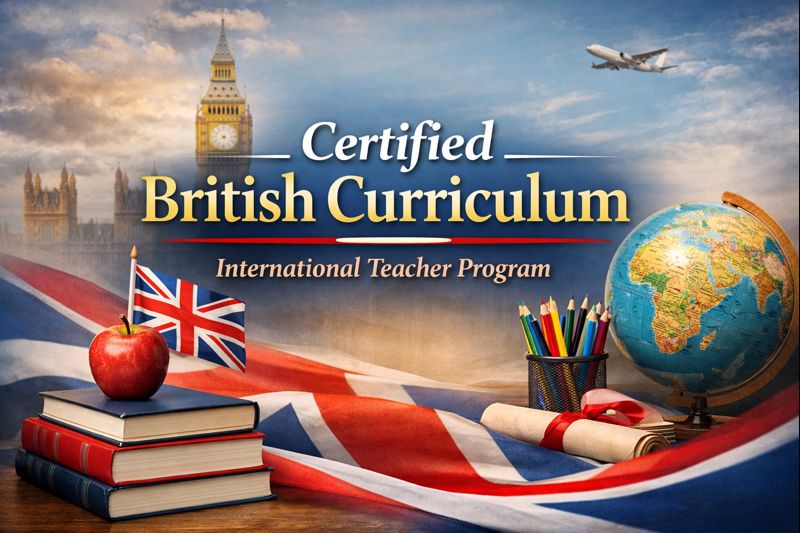
Certified British Curriculum\ International Teacher Program
Level: Short course – Medium level Target audience: Teachers new to or working within the British (UK) Curriculum Purpose: Build practical understanding of the British Curriculum philosophy, teaching, assessment, and classroom practice.
Browse sections — less scrolling.
Full program overview
Introduction to the Certified British Curriculum Teacher ProgramThe Certified British Curriculum Teacher Program is designed to provide teachers with a solid foundation in the philosophy, structure, teaching methodologie...
Introduction to the Certified British Curriculum Teacher Program
The Certified British Curriculum Teacher Program is designed to provide teachers with a solid foundation in the philosophy, structure, teaching methodologies, and assessment practices of the British Curriculum. As one of the most widely adopted education systems globally, the British Curriculum is recognized for its academic rigor, clarity of progression, and strong emphasis on critical thinking, independent learning, and holistic student development. This program aims to equip educators with the knowledge and practical understanding required to effectively deliver the British Curriculum in both national and international school contexts.
The British Curriculum is not merely a collection of subjects or examination requirements; rather, it represents a comprehensive educational framework that balances academic achievement with personal, social, and moral development. Teachers working within this system are expected to adopt learner-centered approaches, use assessment to support progress, and create inclusive learning environments that respond to the diverse needs of students. This course introduces these principles in a structured and accessible manner, ensuring that participants develop confidence and competence in British curriculum teaching.
Overview of the British Curriculum
The British Curriculum, formally known as the National Curriculum for England, provides a clear framework for what students should be taught at different stages of their education. Internationally, it is commonly delivered through pathways such as Cambridge Assessment International Education, which offers globally recognized qualifications including IGCSE and A Levels. Regardless of the pathway used, the core principles of the British Curriculum remain consistent: high expectations, progression over time, and a focus on transferable skills.
One of the defining strengths of the British Curriculum is its emphasis on depth of understanding rather than surface-level memorization. Students are encouraged to question, analyze, apply knowledge, and reflect on their learning. Teachers play a critical role in guiding this process by designing lessons with clear objectives, facilitating meaningful classroom discussions, and providing timely feedback that supports improvement.
Structure of the British Curriculum: Key Stages
The British education system is organized into clearly defined Key Stages, each corresponding to specific age ranges and developmental expectations. This structure ensures continuity and progression throughout a student’s educational journey.
Early Years education begins with the Early Years Foundation Stage (EYFS), which focuses on foundational skills such as communication, social development, and early literacy and numeracy. This stage emphasizes learning through play and exploration, recognizing the importance of early childhood development.
Following EYFS, Key Stage 1 (KS1) covers Years 1 and 2, where students begin formal learning in core subjects such as English, Mathematics, and Science. Key Stage 2 (KS2) extends this learning through Years 3 to 6, deepening subject knowledge and introducing more complex concepts and skills.
Secondary education starts with Key Stage 3 (KS3), which includes Years 7 to 9 and focuses on broad subject exposure and skill development. Key Stage 4 (KS4), typically Years 10 and 11, leads to formal qualifications such as GCSEs or IGCSEs. Finally, Key Stage 5 (KS5) prepares students for higher education through advanced study in A Levels or equivalent programs.
Understanding these Key Stages is essential for teachers, as lesson planning, assessment strategies, and expectations must align with students’ developmental levels.
Teaching and Learning Philosophy
At the heart of the British Curriculum lies a student-centered teaching philosophy. Teachers are expected to move beyond traditional lecture-based instruction and adopt methods that actively engage learners. Lessons are designed to encourage inquiry, discussion, collaboration, and independent thinking.
Effective British curriculum teaching involves:
- Clear learning objectives that are shared with students
- Success criteria that define what achievement looks like
- Opportunities for students to apply knowledge in meaningful contexts
- Reflection and discussion to deepen understanding
Teachers act as facilitators of learning rather than sole transmitters of knowledge. This approach empowers students to take responsibility for their learning and develop lifelong skills such as problem-solving, communication, and critical analysis.
Assessment Practices in the British Curriculum
Assessment within the British Curriculum serves a dual purpose: measuring achievement and supporting learning. Teachers are encouraged to use a range of assessment strategies to monitor progress and inform instruction.
Formative assessment plays a central role and includes classroom questioning, observation, quizzes, peer assessment, and feedback. These methods help teachers identify misconceptions and adjust teaching accordingly. Assessment for Learning (AfL) is a key concept, emphasizing continuous feedback and student involvement in the assessment process.
Summative assessment, such as end-of-unit tests and external examinations (e.g., IGCSEs and A Levels), is used to evaluate overall achievement. However, summative assessment is most effective when supported by strong formative practices throughout the learning process.
Differentiation and Inclusive Practice
The British Curriculum recognizes that students have diverse learning needs, abilities, and backgrounds. As such, differentiation is a core expectation of teaching practice. Differentiation may involve adapting tasks, resources, support, or expected outcomes to ensure all students can access the curriculum and make progress.
Inclusive practice also extends to supporting:
- Students with Special Educational Needs (SEN)
- English as an Additional Language (EAL) learners
- Gifted and talented students
Teachers are expected to create classrooms that promote equity, respect, and participation, ensuring that every learner feels valued and supported.
Classroom Management and the Teacher’s Role
Effective classroom management is essential for successful teaching and learning in the British Curriculum. Well-managed classrooms are characterized by clear routines, consistent expectations, and positive relationships between teachers and students.
The role of the teacher extends beyond instruction to include:
- Modeling professional and ethical behavior
- Encouraging respectful dialogue
- Promoting independence and responsibility
- Monitoring student progress and well-being
By establishing a positive learning environment, teachers enable students to engage confidently and productively in their learning.
Lesson Planning in the British Curriculum
Lesson planning is a critical component of effective British curriculum teaching. A well-structured lesson typically includes:
- Clear learning objectives
- Success criteria
- An engaging starter activity
- Direct instruction or guided learning
- Opportunities for independent or collaborative practice
- A plenary or reflection activity
- Assessment and feedback
This structure ensures coherence, engagement, and measurable learning outcomes. Teachers are encouraged to reflect on their lessons and adapt their planning based on student performance and feedback.
The Importance of Skills Development
Beyond subject knowledge, the British Curriculum places strong emphasis on the development of key skills, particularly critical thinking, problem-solving, communication, and collaboration. These skills prepare students for higher education, employment, and active participation in society.
Teachers play a vital role in embedding these skills within everyday lessons by encouraging questioning, discussion, and application of learning to real-world contexts.
Conclusion
The Certified British Curriculum Teacher Program provides educators with a comprehensive introduction to the principles and practices that define high-quality British curriculum education. By understanding the structure of the curriculum, adopting student-centered teaching strategies, using assessment to support learning, and promoting inclusive classroom environments, teachers can deliver effective and meaningful learning experiences.
This program serves as a foundation for professional growth and excellence in teaching, ensuring that educators are well-prepared to meet the expectations of the British Curriculum and contribute positively to student achievement and development.
Curriculum
Module Title
Foundations of the British Curriculum (England – National Curriculum & Cambridge Pathway)
Learning Material (Study Notes)
1. Overview of the British Curriculum
The British Curriculum is designed to provide a broad, balanced, and coherent education that prepares students academically, socially, and morally. It emphasizes:
- Clear learning objectives
- Progressive skill development
- High academic standards
- Independent thinking
It is commonly delivered through:
- National Curriculum for England
- Cambridge Assessment International Education (CAIE)
2. Key Stages in the British Curriculum
Education is divided into Key Stages, each with specific learning expectations:
| Key Stage | Age Range | Year Groups |
|---|---|---|
| EYFS | 3–5 | Nursery, Reception |
| KS1 | 5–7 | Year 1–2 |
| KS2 | 7–11 | Year 3–6 |
| KS3 | 11–14 | Year 7–9 |
| KS4 | 14–16 | Year 10–11 (IGCSE/GCSE) |
| KS5 | 16–18 | Year 12–13 (A Levels) |
3. Teaching and Learning Approach
British curriculum teaching focuses on:
- Student-centred learning
- Clear lesson objectives
- Differentiation
- Active engagement
- Inquiry-based learning
Teachers are expected to:
- Plan lessons with measurable outcomes
- Use varied strategies (group work, discussion, independent tasks)
- Encourage critical thinking and problem solving
4. Assessment in the British Curriculum
Assessment is used to support learning, not only measure it.
Types of assessment:
- Formative: quizzes, questioning, observation, feedback
- Summative: exams, end-of-unit tests, IGCSE/A-Level exams
- Assessment for Learning (AfL): peer assessment, self-assessment, success criteria
5. Differentiation and Inclusion
Teachers must adapt learning to meet diverse student needs:
- Differentiation by task, support, outcome, or resources
- Support for SEN, EAL, and gifted students
- Inclusive classroom practices
6. Classroom Management and Teacher Role
Effective British curriculum classrooms:
- Have clear routines and expectations
- Promote positive behavior
- Encourage respectful discussion
- Support independent learning
The teacher acts as:
- Facilitator
- Guide
- Assessor
- Role model
7. British Curriculum Lesson Planning
A typical lesson includes:
- Learning objective
- Success criteria
- Starter activity
- Main teaching
- Guided and independent practice
- Plenary / reflection
- Assessment and feedback
Recommended YouTube Learning Resources (for assessment & revision)
You may use any of the following channels or videos for student study and assessment activities:
- Cambridge International – Official Channel
- Search: “Cambridge International teacher training”
- Oak National Academy (UK)
- Search: “British National Curriculum lessons”
- Teach Like a Champion
- Search: “Effective teaching strategies UK classrooms”
- British Council – Teaching English
- Search: “British curriculum teaching methods”
(Students can be asked to watch one video and submit a short reflection or quiz.)
Enroll on this course
Payment method
Full course fee charged once at checkout.
Secure card checkout